Winter Beach Surprises - 2009
Take a walk on the wild side of the refuge in winter and you may have the surprise of a lifetime. Try it.
Yesterday, 13th June, the usual twice yearly bird count under the auspices of the Ornithological Society of New Zealand, took place; a bird count that has taken place on the refuge for many years. Ten people turned up expecting the normal walk up and down the beach but who was to know that this visit to the beach in winter would provide one of the most exciting days on record.
Before we left, the leader did ask if everyone had a plastic bag for beach patrol on the return journey. As an amateur and totally ignorant of the jargon I assumed we were to pick up the rubbish on the beach. Now you would all think that too wouldn't you? 'What a public spirited person,' I thought; kill two birds with one stone. Well maybe this was not an appropriate analogy considering the mission we were on.
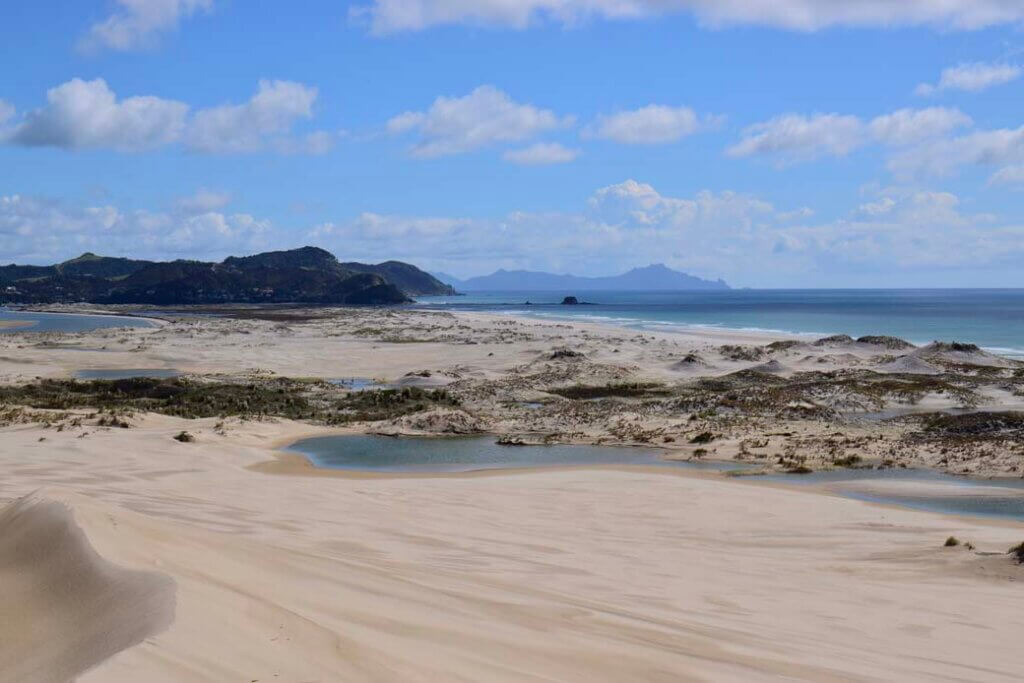
In three groups, well four actually as one group went to the Te Arai stream and found the water roaring straight out of the forest down to the sea, at such a rate and depth they couldn't cross it. Again the stream has changed its course. The other three groups armed with bins and scopes and cameras, one minus the memory card, (note the jargon) set off up the beach. A cold northerly and hard walking had us putting coats on and off. The middens seemed bigger and increased in number as in the recent violent storms the sand had been swept off the surface revealing the colour of intense white like that of the whitest cloud. Set against a blue sky at one point and a black swirling cloud as rain threatened at another, the white of the middens made a picture to retain for quiet memories.
Let's list the events as surprises of the day
Surprise one A fine day warm day after a Friday of torrential constant rain.
Surprise two . Emerging from the forest we had barely walked along the sand when before us was the most amazing sight. Sitting neatly tucked in to itself was an enormous bird with an intense white head, darting black eyes and a beak of the most desirable shade of pink. With one stretch the wings extended to an estimated 3.5m., it settled down again to its resting position. It was so big it was unable to take off from the beach so rather than an exhausted bird the assumption was injury. It was sitting on the tide mark so after close scrutiny and sighs of unbelievable incomprehension the bird was left for our return. Of course you have guessed; it was a snowy wandering albatross later discovered to have come from one of the colonies of Tristan da Cunha, Prince Edward, South Georgia or Cape Crozier in the Antarctic. It does not breed in NZ. To fly it needs the height of a cliff or the surface of a big wave to heave itself off.
Surprise three It was time to get on with the job of recording numbers of the dotties (NZ dotterels) the bandies (banded dotterels), some left behind godwits, a group of white fronted terns seen mingling with big fat Caspian terns, some Variable Oystercatchers ,spur wing plovers and others. The russet of the dotterels' breasts in breeding plumage competed with the red of the pingao. It was then we spied the next exciting find. There against the blue sky was a fluttering hovering fairy tern just checking to see if his patch of shells was still intact. He did not land. A fairy tern on the spit in June is a phenomenon. Most of the Fairy Tern population are still at their winter sites, but the odd alpha-male returns to the breeding grounds as early as June.
At one point we looked back and for 500m we could see the indentations of a pig as it marched across the dunes.
Surprise four We could see across the lagoon the other group inspecting something at great length. Round the lagoon we went to discover David (Project manager for NZFT in the Auckland Conservancy, holding a carcass believe it or not, of another albatross. This time the feathers were a soft black and what's more there was a band on one leg. Even though the wing span was less than the first bird it was still impressive. David recognised it as a light-mantled sooty albatross ; lighter on the back mantle than a sooty albatross and with a streak of blue along its lower bill, originating from one of the Australian sub-Antarctic islands maybe Heard, McDonald or Macquarie. The bands are to be sent to Canberra.
Could there be more?
Surprise five Turning back to the beach after depositing the carcass there was a little fur seal playing on the beach and waves. It is not unusual but I hadn't seen one there before so a delight to watch for the couple of moments it graced us with its presence. Maybe three people were too many for its pleasure.
Surprise six. Our group finally caught up to the others only to find one person had carried along the beach wrapped in her purple jacket a live brown skua. Perhaps it came from Campbell Island, or another of our sub-Antarctic islands. Now skuas are not the nicest of birds but it did have a broken leg so needed help. They are scavengers of the most vicious form but do have a niche in the wild places of our Southern ocean.
That definitely was it. Now it just remained to retrieve the albatross that someone had moved above the tide. There it was sitting awaiting our return.
First David produced some blue tape to put round the bill, an injured bard's most vicious weapon From a backpack came a delicate blue pashmina scarf that was wrapped round the bird that was then lightly lifted up and carried to the car. Standing back I enjoyed the by-play between the experts and they carefully weighed up the alternatives of how to transport the big bird and then where to take it. The skua was easy. He was stuck in a cardboard box with the top down. This gave me time to look at the huge head of the albatross with its layers and layers of tiny fringe like feathers half the size of a little fingernail.
As for the plastic bags and the beach patrol; they were not for rubbish but for the bird carcasses that we were to find. Since 1951 the Orthinological Society of New Zealand has been collecting and monitoring the finds of beach patrols. Our finds this trip, were too big for plastic bags!
Jean Goldschmidt
Follow up Sharon Kast into whose car the precious cargo was deposited sent this message. "I am pleased to report that the albatross arrived in style, sitting comfortably on Eliane's lap in the back seat, wrapped in an aqua pashmina shawl and a matching blue bill tape, complements of David. The brown skua was in a cardboard box, lined with Sioux's newspaper, on the floor between Eliane's feet, a little less elegant. All seemed to be going well until the albatross started to readjust his position in Elaine's arms... then settled down again. We didn't think much of it, until we arrived at Sylvia Durrant's of SPCA Bird Wing an hour away. I think that it would be safe to say that my car is one of very few in NZ that has albatross poo on the back seat and floor. The fishy smell will dissipate in time.
The good news!!! The albatross had a good feed of fish this morning and appeared quite bright eyed and alert. It has a broken centre toe and is sporting a splint, along with a lesser injury on the outside toe, but it needs full use of the foot to survive in the ocean. The prognosis is very good and in 4-5 weeks, it should be ready to join its friends in the Southern Ocean. That is when the real challenge begins....finding a suitable release site. The NZ Navy returned Sylvia's last rehabilitated albatross to the sea. I found it interesting the way that Sylvia feeds an albatross. She has to straddle it like she is riding a horse, pull its head back and put fish down its throat. It sounds awkward, but the bird is hungry and gulps the fish down.
The skua is not looking so good. Its leg is badly broken and it has been that way for some time. Sylvia put a splint on it and is hoping for the best. She is not terribly optimistic that the leg will heal, but has done her best and will keep close tabs on it. Unlike our albatross, it did not enjoy a good feed this morning."

Tony Moore with Albatross
|

